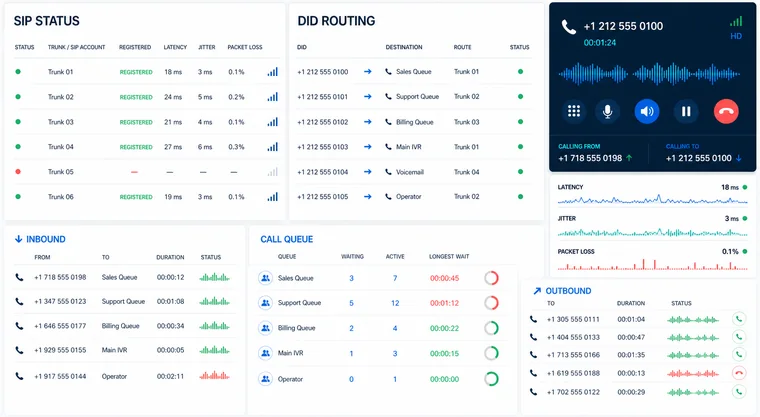
VoIP operations view showing SIP trunk status, active calls and voice quality metrics

SIP voice connectivity

SIP Trunking Provider for PBX and Contact Center Platforms

Plan inbound and outbound business SIP trunking around your platform, concurrency, CPS, destination mix, DID requirements, failover expectations and operating model.

Platform-aware reviewPBX, softswitch and SBC details are part of the plan.
Capacity in contextConcurrency and CPS are reviewed against real call flows.
Numbers connectedInbound requirements can be aligned with DID availability.

A practical SIP trunk

Connect business voice systems without treating every deployment the same.

SIP trunking connects an IP-based phone system to external voice networks for inbound and outbound calling. It can support business PBX platforms, softswitches, contact center systems and communication applications that need a controlled path to telephone destinations and numbers.

The right design depends on the platform and the call flow. Globilinks reviews SIP endpoints, authentication method, expected concurrency, calls per second, codecs, inbound number requirements, outbound destinations and failover expectations before confirming the activation path.

Some teams are replacing an existing trunk, while others are launching a new platform or adding capacity for a defined market. The review is shaped around that operating context. Service availability and technical options are confirmed during the commercial and account process.

Design inputs

A SIP trunk plan should match the platform and the call flow.

Clear technical inputs reduce setup friction and make testing more useful for both teams.

01

Platform and interconnection

Start with the systems that will send and receive traffic. PBX, softswitch, SBC and firewall details help define how signaling and media should be exchanged.

  • SIP platform and version details
  • IP authentication or registration requirements
  • SBC, NAT and firewall considerations
02

Capacity and call behavior

Concurrent calls and calls per second are different requirements. Both should be reviewed alongside average call duration, busy-hour behavior and planned growth.

  • Concurrent call demand
  • CPS and burst expectations
  • Inbound and outbound traffic balance
03

Routing and number requirements

Outbound destinations and inbound DID coverage shape the service. Caller ID presentation, number use and local documentation can also affect what can be provisioned.

  • Destination and route requirements
  • DID markets and number types
  • Caller ID and intended-use review
04

Testing and operational handoff

A trunk should be tested against the call scenarios that matter to the deployment. The handoff includes escalation contacts and a shared view of what should be monitored after launch.

  • Inbound and outbound test cases
  • Codec, DTMF and signaling checks
  • Support and escalation path

Provider evaluation

What to compare in a SIP trunking provider.

The right provider should fit the PBX and the operating model. Use technical, capacity and commercial requirements to compare proposals on equal terms.

PBX and SBC compatibility

Confirm the supported connection method, IP authentication or registration, codecs, DTMF, NAT behavior and any configuration required on the PBX or SBC.

Capacity and charging model

Compare concurrent call paths, CPS, burst behavior, inbound and outbound usage, per-channel or metered charging and the process for adding capacity.

Resilience and testing

Document primary and secondary endpoints, failover behavior, test cases, monitoring responsibilities and the escalation path before cutover.

Numbers and regulatory scope

Check DID availability, number porting, caller ID, emergency-calling responsibilities and market-specific documentation for the countries in scope.

Deployment patterns

Where SIP trunking fits.

PBX replacement or migration

Move from an existing voice connection with a defined test plan for extensions, inbound numbers and outbound calling.

Contact center capacity

Connect a dialer or contact center platform around expected concurrency, CPS, destinations and responsible caller ID use.

Multi-site business voice

Consolidate external voice connectivity for distributed offices while keeping platform and routing requirements visible.

Buyer guide

Size and compare a SIP trunk before configuration starts.

Use the requirements checklist to document call paths, CPS, PBX details, DIDs, codecs, failover and acceptance tests.

Open the SIP checklist

Questions buyers ask

SIP trunking questions before configuration.

These are the details that commonly determine scope, testing and activation readiness.

What is a SIP trunk?

A SIP trunk is an IP-based connection that carries voice signaling and media between a compatible phone platform and external telephone networks. It can support inbound calls, outbound calls or both.

Which platforms can connect to SIP trunking?

Many IP PBX systems, softswitches, SBCs, contact center platforms and communication applications support SIP. Compatibility and the required configuration should be reviewed for the specific deployment.

How much SIP trunk capacity do I need?

Capacity depends on concurrent calls, calls per second, busy-hour behavior, average call duration and planned growth. Share those inputs so the requirement can be reviewed in context.

Can SIP trunks work with global DID numbers?

Inbound DID numbers can route to a compatible SIP endpoint when coverage, documentation and intended-use requirements are met. Number availability varies by market and number type.

What should be tested before launch?

Common checks include inbound and outbound call completion, codecs, DTMF, caller ID presentation, SIP responses, media behavior and the escalation path. The test plan should reflect the actual call flows.

How should I compare SIP trunking providers?

Compare PBX compatibility, connection method, concurrent call capacity, CPS, pricing structure, DID and porting scope, failover design, monitoring, support and market-specific regulatory requirements.

Next step

Bring the platform diagram and expected call load.

Share the PBX or softswitch, concurrency, CPS, destination and number requirements so the trunk can be reviewed around the actual deployment.

Plan SIP capacity