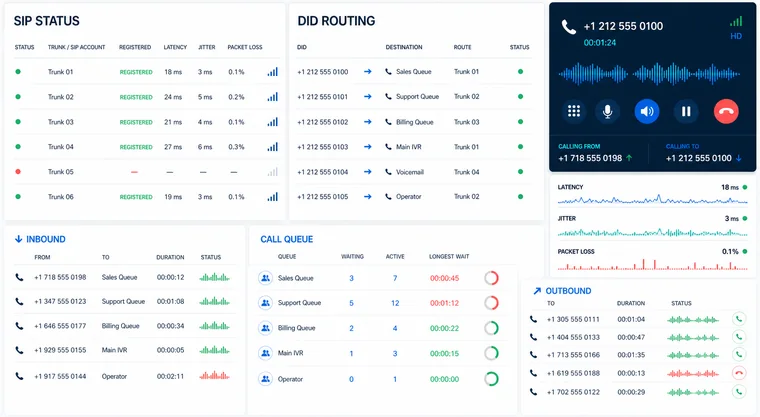
Contact center VoIP operations view with active calls, SIP trunks and voice quality metrics

Contact center VoIP

Contact Center VoIP Provider for BPO and Agent Operations

Connect inbound and outbound calling with SIP capacity, international routing, DIDs and compliance review tied to the way agents and customers actually communicate.

Inbound and outboundNumbers, termination and SIP capacity can be reviewed together.
Operational inputsCPS, concurrency and call duration shape the voice plan.
Responsible onboardingUse case, caller ID and traffic integrity are reviewed before launch.

Voice for agent operations

A contact center voice plan should follow the customer journey.

Contact centers depend on more than a generic trunk. Inbound numbers, queue delivery, outbound destinations, dialer or PBX behavior, concurrent agents, calls per second and caller ID expectations all affect the right voice design.

Globilinks provides the carrier voice connectivity layer for compatible contact center and dialer platforms. It is not a replacement for agent software, workforce management, CRM or a complete contact center as a service platform. This distinction keeps the scope clear for teams that already operate a SIP-capable system and need inbound or outbound voice connectivity.

Globilinks reviews the operating model before confirming a path. Customer service, appointment, support and approved sales workflows can have different destination, volume and compliance requirements. The goal is to make those requirements visible before test traffic and production activity begin.

For outbound operations, share the destinations, expected call duration, CPS, concurrency and campaign purpose. For inbound operations, share the number markets, queue design, receiving SIP platform and expected busy-hour load. Availability and commercial terms are confirmed for the reviewed use case.

Operating model first

Build the voice layer from the call flow outward.

A complete operating profile helps technical, commercial and compliance review move together.

01

Inbound customer access

Map the numbers customers will call, the markets they serve and the queues or teams that should receive each call. Busy-hour concurrency and overflow behavior should be included.

  • DID markets and number types
  • Queue, IVR and routing destination
  • Busy-hour and overflow expectations
02

Outbound traffic profile

Destinations, monthly minutes, calls per second, average call duration and caller ID presentation are core inputs for route review and responsible service use.

  • Country and destination mix
  • CPS, concurrency and call duration
  • Caller ID source and campaign purpose
03

Platform connectivity

The dialer, PBX, contact center platform or SBC determines how signaling and media will be exchanged. Test cases should reflect agent, queue and transfer behavior.

  • SIP platform and endpoint details
  • Codec, DTMF and transfer flows
  • Test users and escalation contacts
04

Compliance and traffic integrity

Globilinks may review business identity, customer authorization, campaign purpose, number use and traffic behavior. Services are intended for lawful business communication and not abusive or deceptive activity.

  • Customer and use-case verification
  • Caller ID and number-use expectations
  • Fraud and abuse indicators

Provider evaluation

What to compare in a contact center VoIP provider.

Contact center voice should be evaluated against the dialer, traffic profile and compliance model. Separate carrier connectivity requirements from agent-software features.

Voice layer versus software

Confirm whether you need SIP connectivity, DIDs and termination for an existing platform or a complete CCaaS application with queues, agents, recording and reporting.

CPS and concurrency fit

Model call attempts per second, active calls, busy-hour demand, average call duration, campaign schedules and the process for scaling capacity.

Caller ID and use-case review

Document the client, campaign purpose, number rights, destination rules, consent expectations and controls used to prevent misleading or abusive calling.

Quality and escalation

Define test traffic, ASR, ACD, PDD, SIP-code review, audio checks, incident ownership and the support path for live campaign windows.

Agent workflows

Where contact center voice fits.

Customer service and support

Route inbound DIDs to queues and give agents an outbound path for approved customer follow-up.

BPO client programs

Review each client use case, destination mix and caller ID plan before traffic is introduced to the voice platform.

Distributed agent teams

Connect a cloud or SIP-enabled contact center while keeping capacity, routing and escalation requirements defined.

Buyer guide

Check the voice layer before a campaign or queue goes live.

Use the readiness checklist to align platform, traffic, DIDs, caller ID, compliance, testing and escalation responsibilities.

Open the readiness checklist

Questions buyers ask

Contact center voice questions before launch.

The platform and use case determine the right answer. Start with these common planning questions.

What information is needed for a contact center VoIP quote?

Share the inbound and outbound call flows, destinations, monthly minutes, CPS, concurrency, average call duration, number markets, caller ID plan, platform details and business use case.

Can Globilinks support both inbound and outbound contact center calls?

Inbound DID routing and outbound termination can be reviewed as one operating requirement. Availability, technical design and commercial terms depend on the markets, platform and approved use case.

How do CPS and concurrency affect a contact center?

CPS measures how quickly new calls are attempted, while concurrency measures how many calls are active at once. Both can affect capacity planning, testing and route suitability.

Does caller ID need to be reviewed?

Yes. Caller ID presentation should match the authorized business use, number rights, destination requirements and applicable rules. Misleading or unauthorized caller ID use is not permitted.

Can a dialer connect over SIP?

A SIP-capable dialer or contact center platform may be able to connect when technical and account requirements are met. Platform details, traffic behavior and test scenarios should be reviewed first.

Is contact center VoIP the same as CCaaS software?

Not always. Contact center VoIP can describe the carrier voice layer that connects an existing dialer or contact center platform to telephone networks. CCaaS usually includes agent applications, queues, reporting and other software features. Confirm which layer is included when comparing providers.

Next step

Share the platform, call flow and traffic profile.

Globilinks will review capacity, destinations, numbers, caller ID expectations and onboarding requirements before a service path is confirmed.

Review your call flow