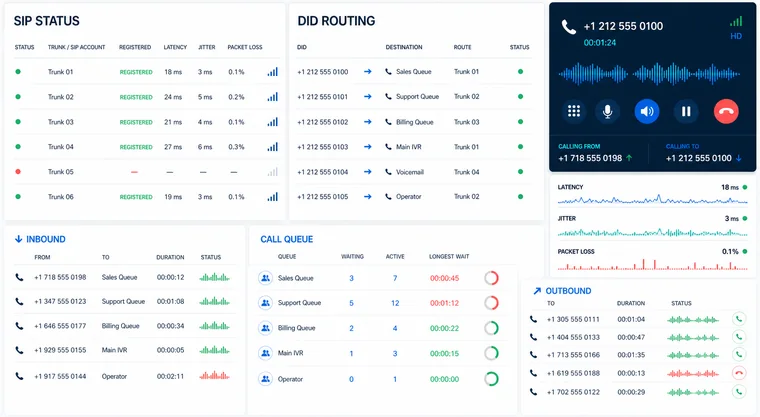
VoIP operations dashboard showing SIP trunks, call queues and route performance for a contact center

Dialer voice integration

VICIdial SIP Trunking for Call Center Operations

Globilinks reviews VICIdial carrier connectivity around the server topology, SIP peer settings, campaign traffic, CPS, concurrency, destinations, caller identity and a controlled production test.

Campaign-awareDialing method, pacing and retries inform the traffic review.
SIP settings alignedPeer, codec, DTMF and number formats are checked together.
Staged launchTest traffic is increased through agreed checkpoints.

From campaign to carrier

VICIdial controls the dialing workflow; the SIP trunk carries the voice.

VICIdial is a contact center dialer platform that can originate outbound campaigns and manage inbound agent workflows. A carrier SIP connection supplies the external voice path, while VICIdial handles campaign logic, agents, lists, queues and reporting. Keeping those responsibilities clear makes configuration and troubleshooting more effective.

Globilinks reviews the VICIdial or cluster topology, Asterisk version, public IP addresses, carrier definition, authentication, codecs, DTMF, dialplan and number format. The traffic review adds campaign destinations, expected minutes, normal and burst CPS, concurrency, retry behavior, average call duration and caller identity.

VICIdial is a third-party platform. Globilinks is not affiliated with or endorsed by the VICIdial project. Integration scope and service availability are confirmed for each environment; customer administrators remain responsible for their application configuration, campaigns and lawful use.

Integration scope

The configuration path from VICIdial to a tested SIP route.

A stable connection depends on both the carrier definition and the way campaigns generate signaling and media traffic.

01

Inventory the VICIdial environment

Record the VICIdial and Asterisk versions, server roles, signaling and media IPs, NAT or firewall path, existing carriers and the administrator responsible for changes and rollback.

  • Server or cluster topology
  • Public signaling and RTP addresses
  • Change owner and rollback plan
02

Build the SIP carrier definition

Align the agreed authentication method, host or IP, transport, codecs, DTMF, caller ID fields, destination number format and outbound dialplan. Keep credentials out of tickets and public screenshots.

  • Peer and authentication settings
  • Codec, DTMF and caller ID fields
  • E.164 or agreed dial-string normalization
03

Map campaign traffic to capacity

Translate campaign dialing mode, pacing, retries and schedule into normal and burst CPS, active calls and bandwidth. Set an initial ceiling that can be increased after representative route and system behavior is reviewed.

  • Campaign mode and dial level
  • Normal and burst call attempts
  • Concurrency, bandwidth and scale-up stages
04

Test calls and failure behavior

Validate outbound and inbound flows, two-way audio, DTMF, transfers, caller ID, hangup causes and representative destinations. Record SIP traces and timestamps for any failure without exposing customer data.

  • Functional call-flow checks
  • SIP responses and route observations
  • Evidence format and escalation contacts

Provider evaluation

What to confirm before connecting VICIdial to a provider.

The provider should be able to discuss dialer behavior and SIP evidence without pretending to own the application layer.

Clear technical boundary

Confirm who configures VICIdial, firewalls, SBCs and carrier settings, and who investigates the external voice route when a call fails.

CPS and concurrency fit

Share the campaign pacing and peak attempt behavior so signaling limits are sized separately from active-call capacity.

Route test method

Agree on destinations, test volume, caller identity, timestamps and the metrics or SIP evidence used to evaluate the result.

Operational controls

Define spend limits, fraud monitoring, authorized campaigns, escalation ownership and the process for pausing unusual traffic.

VICIdial workflows

Common ways the voice layer supports the dialer.

Outbound campaign termination

Route approved destination traffic from VICIdial campaigns with documented pacing, CPS, concurrency and caller identity.

Inbound DID delivery

Deliver numbers to inbound groups, queues or IVR logic with the expected number format and failover behavior.

Carrier migration and troubleshooting

Test a new route or investigate call setup, media, DTMF and hangup issues using repeatable call examples and SIP evidence.

Buyer guide

Document the SIP requirements before changing the dialer.

Use the checklist to capture network, capacity, codec, number, failover and acceptance-test details for the integration.

Open the SIP checklist

Questions buyers ask

VICIdial SIP trunking questions

The exact settings depend on the environment. These answers cover the information needed to start safely.

Can Globilinks connect a SIP trunk to VICIdial?

Globilinks can review SIP connectivity for a documented VICIdial environment. Activation depends on account review, network readiness, traffic requirements, destination availability and agreement on the configuration and test scope.

Which VICIdial settings are needed for a SIP carrier?

Typical inputs include the server or cluster IPs, authentication method, host, codecs, DTMF, caller ID fields, destination number format and dialplan. Exact settings depend on the VICIdial and Asterisk versions and network design.

How do VICIdial campaigns affect CPS?

Dialing mode, dial level, retries, list quality and answer behavior can generate call attempts much faster than calls connect. Share the expected burst pattern so CPS is reviewed separately from concurrent channels.

Can the same setup receive inbound DIDs?

Inbound DIDs can be mapped to an agreed SIP destination, but VICIdial inbound groups, number formats, busy-hour capacity, overflow and failover should be configured and tested separately.

Is Globilinks affiliated with VICIdial?

No. VICIdial is a third-party platform and its names belong to their respective owners. Globilinks provides independent SIP and voice-integration services for compatible customer environments.

Next step

Review the VICIdial traffic before changing the carrier.

Share the platform version, server topology, destination mix, campaign behavior, CPS, concurrency and caller identity plan for a focused integration review.

Review your VICIdial setup